Ear Reading Is Still Reading: What Audiobooks Actually Do for Kids
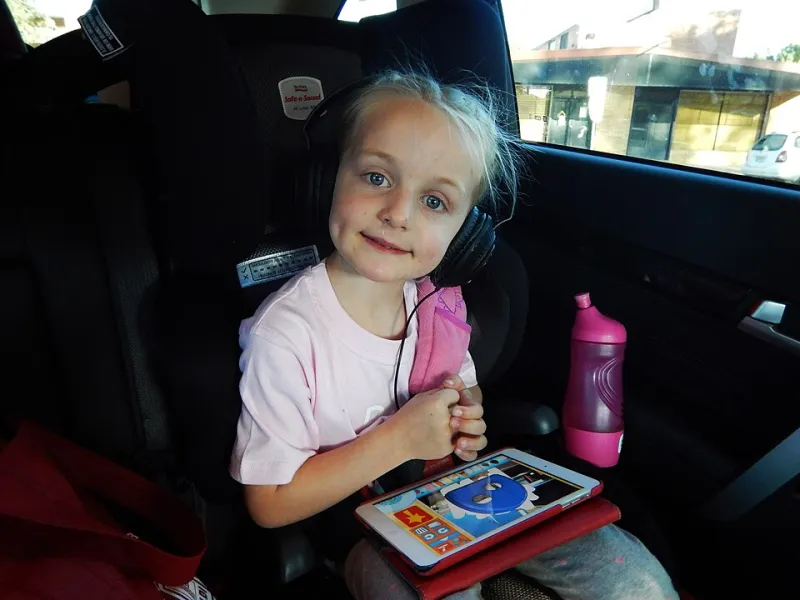
Photo: Tom Reynolds from Melbourne, Australia, CC BY 2.0, via Wikimedia Commons
A parent stops at the library desk and says it in a half-whisper, the way you'd confess something: 'He's not really reading. He's just listening.'
It's one of the most common things children's librarians hear, and it deserves a real answer instead of a polite nod. So let's give it one.
Listening and reading use the same machinery
Reading is not one skill. It's at least two — decoding the words on the page, and making meaning out of them. Audiobooks skip the first part entirely. They go straight to the second.
The comprehension engine that audiobooks build is the same engine print reading uses: vocabulary, sentence structure, background knowledge, the ability to hold a character's motivation in your head across thirty chapters. A kid listening to a story is doing all of that work. What they aren't doing is practicing letter-sound correspondence, which is why listening alone won't teach a child to decode. But it's also why listening is not a lesser version of reading. It's a different doorway into the same house.
A growing body of literacy research backs up what teachers have noticed for years: kids with access to audiobooks show gains in vocabulary and listening comprehension, and struggling readers in particular benefit from hearing fluent, expressive narration. That expressiveness matters. When a narrator pauses before a punchline or stretches a vowel to show dread, a kid is learning prosody — the rhythm of meaning — which is one of the things that makes reading sound like a voice in your head instead of a list of words.
And there's a quietly enormous benefit for kids who read below grade level: they can listen to books at their thinking level, not their decoding level. Comprehension keeps growing while skills catch up.
Four myths worth retiring
'It's cheating.' It isn't. Nobody accuses a commuter of cheating at novels because they listened to one. The goal was never to move your eyes across paper. The goal was the story.
'They'll never go back to print.' Not what usually happens. Audiobooks often function as an on-ramp — kids hear the first book in a series and then want to read the rest themselves, sometimes because they can't wait for the next download.
'It doesn't help with decoding.' Correct, and worth naming honestly. It's not a substitute for phonics instruction or print practice. It's a companion.
'Audiobooks are only for reluctant readers.' Plenty of voracious readers listen. Some kids are simply auditory. Some have long car rides. Some find print exhausting for reasons that have nothing to do with skill.
Making listening count for more
If you want the experience to go deeper than background noise, a few small moves go a long way.
Follow along for the first chapter. Kids who are building print skills can listen to the opening of a book with the physical copy open in front of them. The voice and the letters start to line up, and the story gets anchored in the page.
Slow it down. Most audio apps let you drop the speed. For younger or newer listeners, 0.9x often makes the difference between lost and hooked.
Listen together sometimes. A shared audiobook in the car turns a commute into a family book club with no meeting required. Fifteen minutes a day gets you through a middle grade novel in about a month.
Stack the series. Listen to book one. Read book two. The momentum is already there, and the characters feel like people they know.
Get a library card. In the US, most public libraries offer free audiobook downloads through apps like Libby or Hoopla, along with playaway devices and read-along kits for kids who want the audio and the book in one package. Ask the children's desk what they have. The answer is usually more than you'd expect.
Three writing prompts to try after a listen
The fastest way to see whether a story landed is to ask a kid to make something out of it.
Write the next scene from a minor character's point of view. Write a letter from the villain explaining themselves. Write the same event again, but set it in your own town. Kids who finish a listen with a notebook open in front of them are doing the deep work of narrative — the kind that shows up in their own writing later.
A note on screen-free
Audiobooks are often sold as a screen-time compromise, and that's fine as far as it goes. But it undersells them. A child listening in the kitchen while they build something is doing something older than screens entirely — the same thing that happened around a fire, or on a porch, or in a car with a parent narrating a story that someone else wrote a hundred years ago.
So the next time a kid hands you the earbuds and says they'd rather listen than read, you can say the true thing: that's reading too. Now tell me what's happening in the story.