One More Chapter: The Science Behind Kids Who Can't Put Books Down at Bedtime
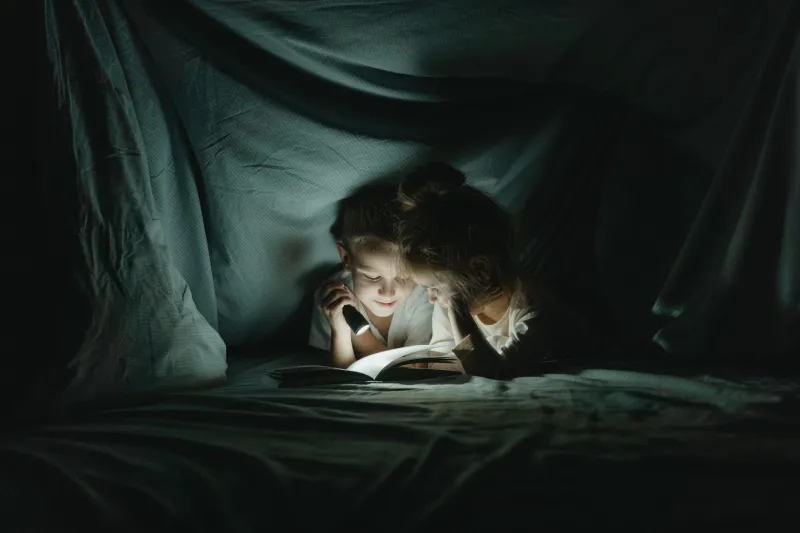
You've done everything right. Teeth brushed. Pajamas on. Lights out at 8:30. And then, sometime around 10 p.m., you walk past your kid's room and catch a telltale glow sneaking out from under the door. Your child — the same one who claims to be "so tired" at dinner — is wide awake, flashlight in hand, absolutely glued to a book.
Parents across the country know this scene well. And honestly? It's complicated. On one hand, your kid is reading. Voluntarily. At night. That's kind of amazing. On the other hand, sleep matters, and tomorrow morning is going to be rough.
So what's actually going on when a book becomes more powerful than exhaustion — and what should parents do about it?
Why Some Books Feel Impossible to Put Down
Not every book gets the flashlight treatment. Plenty of perfectly good stories get finished in reasonable chunks, bookmarked neatly, and set on the nightstand like a civilized person. But then there are those books — the ones that seem to grab kids by the brain and refuse to let go.
What makes the difference?
Child development specialists point to a few key ingredients. Open story loops are a big one. When an author ends a chapter on a cliffhanger — a character in danger, a secret half-revealed, a door left open — the brain genuinely struggles to rest. It's not just a feeling; our minds are wired to seek resolution. Leaving a story unfinished can feel almost physically uncomfortable.
Then there's character attachment. When kids deeply identify with a protagonist — when they see themselves in that character's fears, hopes, or sense of humor — reading stops feeling like entertainment and starts feeling like checking in on a friend. Closing the book means leaving that friend mid-sentence.
Pacing and chapter length play a role too. Many authors who write for middle-grade readers are deliberate about keeping chapters short and punchy. Short chapters create a kind of treadmill effect: just one more, just one more, just one more. Before a kid knows it, it's midnight.
What's Happening in Your Child's Brain
Here's where it gets genuinely interesting. When a child is deeply absorbed in a story, they're experiencing something researchers call "narrative transportation" — a state where the brain is so immersed in a fictional world that it partially disengages from the real one. Time distortion is a hallmark of this state. An hour can genuinely feel like fifteen minutes.
This isn't just poetic language. Brain imaging studies have shown that reading vivid fiction activates many of the same neural regions involved in real lived experience. Your child isn't passively receiving a story — they're inhabiting it. Their brain is working hard, processing language, building mental images, tracking characters and plot threads, and even generating emotional responses.
From a neurological standpoint, that level of engagement is actually hard to just... switch off. Asking a kid to stop reading mid-chapter can feel a bit like asking someone to pause a dream.
The Sleep Piece: Why It Actually Matters
None of this means parents should just shrug and let the flashlight situation continue indefinitely. Sleep is genuinely important for children — not in a nagging, lecture-y way, but in a real, measurable way. Kids who consistently don't get enough sleep show impacts on mood, memory, attention, and even immune function. The American Academy of Sleep Medicine recommends 9–12 hours for school-age kids, and most aren't hitting that on a good day.
There's also the screen-free irony to consider. We work hard to limit screens before bed because blue light disrupts melatonin production. Books don't have that problem — but a child who's mentally revved up from a tense plot twist isn't exactly in a calm, sleep-ready state either. Cognitive stimulation, regardless of source, can delay sleep onset.
So the goal isn't to discourage reading. It's to find a rhythm that honors both the love of books and the body's need for rest.
Practical Ways to Navigate Bedtime Reading
Parents who've figured this out tend to share a few common strategies — and the good news is, none of them involve banning books from the bedroom.
Build in a real reading window. Instead of treating reading as something that happens after everything else, give it its own dedicated slot earlier in the evening. Thirty to forty-five minutes of reading time before the official wind-down routine can satisfy the itch without derailing sleep.
Use chapter breaks as natural stopping points. Before your child starts reading for the night, agree together on a stopping point — the end of a specific chapter, not just a vague "in a little while." Kids are more likely to honor a concrete boundary they helped set.
Try the "last chapter" rule. Some families allow one chapter after lights-out — actual lights, not a flashlight — and that's it. It gives kids something to look forward to while still putting a limit on things.
Talk about the book. One underrated trick: spend five minutes at bedtime chatting about what your kid read that day. It gives them a way to process the story out loud, which can actually make it easier to mentally set it down. Bonus — it's great for their comprehension and for your relationship.
Let them feel the consequence sometimes. If a child stays up too late reading and is exhausted the next day, that's actually a pretty natural teacher. You don't have to rescue the situation every time. Kids learn to self-regulate when they experience real outcomes.
The Bigger Picture
Here's something worth sitting with: a child who loves books so much they lose track of time is a child who has found something genuinely meaningful. That's not a problem to solve — it's a gift to protect.
The tension between encouraging reading and protecting sleep is real, but it's also manageable. The families that navigate it best tend to be the ones who treat reading as something worth taking seriously enough to build real structure around — not something that just happens in the margins of the day.
So the next time you see that glow under the door, take a breath before you knock. Your kid isn't being defiant. They're just really, really into a story.
And honestly? There are worse problems to have.